
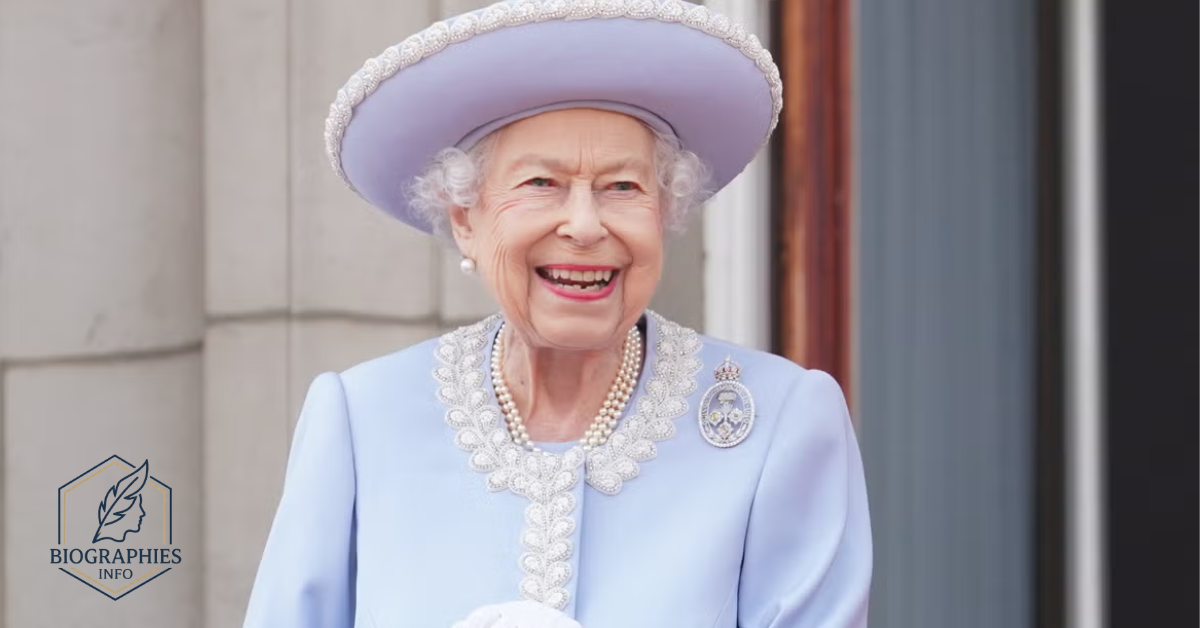
Elizabeth II ruled the United Kingdom for 70 years, longer than any other British monarch in history. She was never supposed to be queen. However, life took a different turn, and she went on to guide her country through war recovery, massive social change, and the end of the British Empire.
Discover the extraordinary life of Queen Elizabeth II, from her childhood and marriage to her historic reign, wealth, and enduring legacy, in one complete biography.
Quick Facts
| Fact | Detail |
|---|---|
| Full Name | Elizabeth Alexandra Mary |
| Born | April 21, 1926, London, England |
| Died | September 8, 2022, Balmoral Castle, Scotland |
| Age at Death | 96 |
| Reign | February 6, 1952 – September 8, 2022 |
| Length of Reign | 70 years, 214 days |
| House | Windsor |
| Predecessor | George VI |
| Successor | Charles III |
| Spouse | Prince Philip, Duke of Edinburgh |
| Children | Four |
| Coronation | June 2, 1953, Westminster Abbey |
| Net Worth | $450–600 million (estimated) |
Early Life and Childhood
Elizabeth II was born on April 21, 1926, at 17 Bruton Street in Mayfair, London. Her family didn’t expect her to become queen. She was third in line to the throne at birth, behind her uncle Edward and her father.Everything changed in 1936. Her uncle, King Edward VIII, gave up the throne to marry an American divorcee.
Elizabeth’s father became King George VI overnight. Suddenly, ten-year-old Elizabeth stood next in line for the crown.Friends and family described her as calm, dutiful, and serious for her age. She grew up fast, knowing one day the whole country would look to her for leadership.
Family Background
Elizabeth came from the House of Windsor, one of the most recognized royal families in the world. Her father was King George VI. Her mother was Elizabeth Bowes-Lyon, later known as the Queen Mother. She had one sibling, her younger sister Princess Margaret, born in 1930.
Family Tree
Here’s a quick look at how her closest family connects.
| Relation | Name |
|---|---|
| Father | King George VI |
| Mother | Elizabeth Bowes-Lyon (Queen Mother) |
| Sister | Princess Margaret |
| Husband | Prince Philip, Duke of Edinburgh |
| Children | Charles, Anne, Andrew, Edward |
| Grandchildren | Eight, including Prince William and Prince Harry |
Education
Elizabeth never attended a traditional school. She learned at home through private tutors, a common practice for royal children at the time.Her governess, Marion Crawford, taught her reading, writing, and history. Later, a constitutional expert named Henry Marten tutored her privately at Windsor.
He prepared her for the legal and political duties a future monarch would need to understand.She also learned French fluently, a skill that served her well during decades of state visits across the world.
Military Service
World War II reshaped Britain, and it reshaped young Elizabeth too.
In 1945, at age 18, she insisted on serving her country directly. She joined the Auxiliary Territorial Service (ATS), the women’s branch of the British Army.
- She trained as a mechanic and truck driver.
- She learned to repair engines and change tires herself.
- She became the first female member of the royal family to serve as a full-time active member of the armed forces.
This experience shaped her sense of duty for the rest of her life.
Rise to the Throne
The path to the throne was not originally expected for Princess Elizabeth. However, a major royal event changed her future and prepared her for a lifetime of service. In 1952, after the death of her father, King George VI, Elizabeth became Queen and began a reign that would last for more than 70 years, making her the longest-reigning monarch in British history.
Father’s Death and Accession
King George VI died on February 6, 1952. Elizabeth was in Kenya at the time, on a royal tour with her husband. She learned she was queen while sitting in a treehouse lodge in the African wilderness. She flew home immediately as the new monarch.
Coronation
Her coronation took place on June 2, 1953, at Westminster Abbey. It was the first coronation ever broadcast live on television, watched by millions around the world.
Quick Fact: Over 8,000 guests attended the coronation in person, while an estimated 27 million people in Britain watched it on TV.
Marriage and Personal Life
Queen Elizabeth II’s personal life reflected the same sense of duty and commitment that defined her reign. Despite the demands of being Britain’s longest-serving monarch, she valued her family and maintained a strong partnership with Prince Philip throughout their 74-year marriage.
Husband: Prince Philip
Elizabeth married Philip Mountbatten, later known as the Duke of Edinburgh, on November 20, 1947, at Westminster Abbey. The two had actually met years earlier, in 1934, and stayed in touch through letters during the war.Their marriage lasted 74 years, making it the longest marriage of any British monarch. Prince Philip passed away in April 2021, just over a year before the Queen’s own death.
Children
Elizabeth and Philip had four children together, spaced out across sixteen years.
| Name | Born | Title |
|---|---|---|
| Charles | November 14, 1948 | Now King Charles III |
| Anne | August 15, 1950 | Princess Royal |
| Andrew | February 19, 1960 | Duke of York |
| Edward | March 10, 1964 | Duke of Edinburgh |
Major Life Events
A lot happened across 70 years. This table captures the biggest moments at a glance.
| Date | Event |
|---|---|
| 1947 | Marries Prince Philip |
| 1952 | Becomes Queen |
| 1953 | Coronation at Westminster Abbey |
| 1977 | Silver Jubilee |
| 2002 | Golden Jubilee |
| 2012 | Diamond Jubilee |
| 2017 | Sapphire Jubilee |
| 2021 | Death of Prince Philip |
| 2022 | Platinum Jubilee |
| 2022 | Death at Balmoral Castle |
The Reign of Elizabeth II
Queen Elizabeth II’s reign lasted from 1952 to 2022, making it the longest reign in British history. During these 70 years, she witnessed major political, social, and technological changes while remaining a symbol of stability and continuity for the United Kingdom and the Commonwealth.
Duties as Head of State
As queen, Elizabeth II carried out constitutional duties every single day. She met weekly with the sitting prime minister. She opened Parliament. She signed laws passed by the government. She represented Britain on the world stage.
Constitutional Role
Britain runs on a constitutional monarchy. This means the monarch reigns, but doesn’t rule directly. Elizabeth stayed neutral on political issues her entire life. She never voted, and she never publicly shared her personal political opinions.
Relationship With Prime Ministers
Elizabeth worked with 15 different prime ministers during her reign, starting with Winston Churchill and ending with Liz Truss.
- She met with Winston Churchill weekly during her early reign and valued his guidance.
- She built a close working bond with Margaret Thatcher, Britain’s first female prime minister.
- She welcomed Tony Blair into office as the youngest prime minister in nearly 200 years.
- She met Liz Truss just two days before her own death, her final official duty.
Relationship With the Commonwealth
Elizabeth served as Head of the Commonwealth, a group of nations with historic ties to Britain. She traveled more than any other monarch in history, visiting over 100 countries during her reign.
- She helped guide former colonies through independence.
- She supported the growth of the Commonwealth from a handful of nations to over 50 member states.
- She gave regular Commonwealth Day addresses promoting unity and cooperation.
Leadership Style
Elizabeth led through consistency, not flash. She rarely gave interviews. She avoided public controversy. Her strength came from steady presence, not loud opinions.
She believed in service above self. She once said her whole life, whether long or short, would be devoted to serving her people. She kept that promise for over seven decades.
Major Achievements
These stand out as the moments that defined her time on the throne.
| Achievement | Year | Significance |
|---|---|---|
| Longest-reigning British monarch | 2015 | Surpassed Queen Victoria’s record |
| Platinum Jubilee | 2022 | Celebrated 70 years on the throne |
| Modernized the monarchy | Ongoing | Introduced televised events, social media presence |
| Guided Commonwealth expansion | Ongoing | Grew from 8 to 54 member nations |
| First monarch to send an email | 1976 | Early adopter of new technology |
Challenges and Controversies
No 70-year reign is without challenges. Elizabeth II faced many difficulties that tested her leadership and resilience.
- Public criticism after Princess Diana’s death in 1997 for staying silent too long.
- Ongoing debate about the monarchy’s cost to taxpayers.
- Family scandals involving her children’s marriages and divorces.
- Controversy surrounding Prince Andrew’s association with Jeffrey Epstein.
- Renewed questions about the monarchy’s historical ties to colonialism.
Through each challenge, Elizabeth generally responded with restraint rather than public confrontation.
Hobbies and Interests
- Corgis — She owned more than 30 Pembroke Welsh Corgis throughout her life, starting with one named Susan in 1944.
- Horses — She rode horses well into her 90s and bred racehorses for decades.
- Countryside life — She loved walking and relaxing at her private estates in Scotland and Norfolk.
- Stamp collecting — She inherited and expanded one of the world’s most valuable royal stamp collections.
Elizabeth II Net Worth
Estimated Net Worth
Quick Fact: At the time of her death, Elizabeth II’s personal net worth was estimated between $450 million and $600 million, depending on the source.
Sources of Wealth
Her wealth came from a mix of inheritance, personal investments, and income tied to her role as monarch. It’s important to separate her personal wealth from the much larger Crown Estate, which she did not personally own but held in trust for the nation.
Personal Assets
- Two privately owned estates: Balmoral Castle and Sandringham House.
- A jewelry collection valued at over $100 million.
- One of the world’s most valuable stamp collections, inherited from her grandfather.
- Art, horses, and other personal collections built over decades.
Royal Properties
Not everything linked to the Queen belonged to her personally. Some palaces were hers to live in, but not hers to own. The table below makes that distinction clear.
| Property | Ownership Type | Estimated Value |
|---|---|---|
| Buckingham Palace | Crown property (not personal) | N/A |
| Windsor Castle | Crown property (not personal) | N/A |
| Balmoral Castle | Personally owned | Around $140 million |
| Sandringham House | Personally owned | Around $65 million |
Investments
Elizabeth held a private investment portfolio managed discreetly through her financial advisors. Exact details were never made fully public, in keeping with royal tradition.
Valuable Collections
- Royal jewelry and tiaras
- The Royal Philatelic Collection (rare stamps)
- Fine art and historic artifacts
- Prized racehorses and breeding stock
Income Sources
- The Privy Purse — income from the Duchy of Lancaster estate.
- The Sovereign Grant — public funding covering official royal duties, not personal spending.
- Personal investments — private wealth managed independently.
Financial Facts
- She inherited a portion of her mother’s estate in 2002.
- She inherited part of Prince Philip’s estate after his death in 2021.
- She was, for decades, the wealthiest woman in the United Kingdom.
Net Worth Breakdown Table
Here’s a simple snapshot pulling all her major assets into one place.
| Category | Estimated Value |
|---|---|
| Personal net worth | $450–600 million |
| Balmoral Castle | $140 million |
| Sandringham House | $65 million |
| Jewelry collection | $100+ million |
| Stamp collection | Over $130 million |
Awards and Honors
Beyond her role as monarch, Elizabeth received dozens of honors from Britain and countries around the world. A few stand out above the rest.
| Award | Year Received | Awarding Body |
|---|---|---|
| Order of the Garter | 1947 | British monarchy |
| Order of the Thistle | 1952 | British monarchy |
| Royal Victorian Chain | 1953 | British monarchy |
| Numerous honorary foreign orders | Throughout reign | Various nations |
Books About Elizabeth II
Her life has inspired dozens of biographies over the decades. These are some of the most respected and widely read.
| Title | Author | Year | Focus |
|---|---|---|---|
| Elizabeth the Queen | Sally Bedell Smith | 2012 | Full-life biography |
| The Diamond Queen | Andrew Marr | 2011 | Monarchy and modern Britain |
| Queen of Our Times | Robert Hardman | 2022 | Her full reign and legacy |
| Our Queen | Robert Hardman | 2011 | Behind-the-scenes royal life |
Famous Quotes
- “I have to be seen to be believed.”
- “Grief is the price we pay for love.”
- “It’s worth remembering that it is often the small steps, not the giant leaps, that bring about the most lasting change.”
Interesting Facts
- She was the first British monarch to send an email, back in 1976.
- She celebrated two birthdays each year: her actual birthday and an official public one in June.
- She never carried cash; she had no need to.
- She met 13 different U.S. presidents during her reign.
- She was a trained mechanic who could fix a car engine herself.
- Her Christmas broadcast tradition began in 1957 and continued every year after.
Timeline of Elizabeth II’s Life
For a quick recap of her full life, here’s the timeline from birth to death.
| Year | Event |
|---|---|
| 1926 | Born in London |
| 1936 | Becomes heir presumptive after her uncle’s abdication |
| 1945 | Serves in the ATS during World War II |
| 1947 | Marries Prince Philip |
| 1952 | Becomes Queen |
| 1953 | Coronation |
| 1977 | Silver Jubilee |
| 2002 | Golden Jubilee |
| 2012 | Diamond Jubilee |
| 2021 | Prince Philip dies |
| 2022 | Platinum Jubilee, then dies in September |
Death
Elizabeth II died on September 8, 2022, at Balmoral Castle in Scotland. She was 96 years old. Buckingham Palace confirmed she passed peacefully, surrounded by close family.Her death came just two days after she appointed Liz Truss as prime minister, her final official act as monarch.
Funeral
Her state funeral took place on September 19, 2022, at Westminster Abbey. It was one of the largest state events in British history.
- Her body lay in state at Westminster Hall for four days.
- Hundreds of thousands of mourners waited in a queue that stretched for miles.
- World leaders from over 100 countries attended the funeral.
- She was laid to rest at St George’s Chapel, Windsor Castle, beside Prince Philip.
Legacy and Impact
Elizabeth II left behind a monarchy that survived massive change without collapsing. She guided Britain through the decline of empire, the rise of television, and the shift into a digital world, all while keeping the institution stable. She proved that quiet consistency can hold more power than loud authority. Her steady leadership shaped how the entire world views modern monarchy today.
Conclusion
Elizabeth II never asked to be queen. Yet she carried the role with steady hands for seven decades. She watched the world transform around her, and through every change, she stayed a symbol of stability.Her legacy isn’t loud speeches or dramatic gestures. It’s the quiet, consistent duty she gave her country every single day, for 70 straight years.
Frequently Asked Questions
How long did Elizabeth II reign?
She reigned for 70 years and 214 days, making her the longest-reigning monarch in British history.
Who succeeded Elizabeth II?
Her eldest son, King Charles III, succeeded her immediately upon her death.
What was Elizabeth II’s net worth?
Estimates place her personal net worth between $450 million and $600 million at the time of her death.
How did Elizabeth II die?
She died of natural causes related to old age at Balmoral Castle in Scotland.
Who was Elizabeth II married to?
She was married to Prince Philip, Duke of Edinburgh, for 74 years, until his death in 2021.