
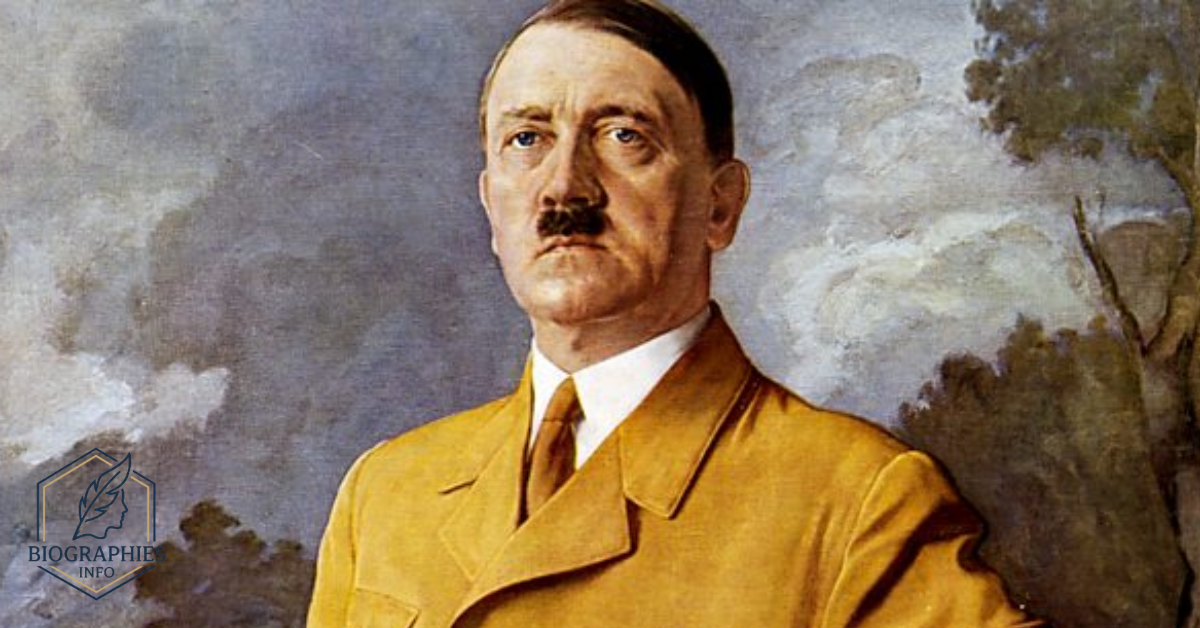
Adolf Hitler was a German politician who led Nazi Germany from 1933 to 1945. His dictatorship reshaped Europe, triggered World War II, and was responsible for the Holocaust, the systematic murder of six million Jews and millions of other victims. His rise to power, political ideology, and decisions remain among the most studied subjects in modern history.
Explore Adolf Hitler’s extraordinary rise to power, examining his early life, military service, political career, leadership during World War II, major policies, downfall, death, and enduring historical impact. Based on verified historical records, this biography offers a comprehensive and objective account of one of the most consequential leaders in modern history.
Who Was Adolf Hitler?
Adolf Hitler was a German politician and leader of the Nazi Party who became one of the most influential and controversial figures in modern history. Born in Austria in 1889, he moved to Germany, served in the First World War, and later entered politics during a period of economic hardship and political instability.
Through powerful speeches, propaganda, and the rapid growth of the Nazi Party, Hitler rose to become Chancellor of Germany in 1933. He soon established a one-party dictatorship, eliminating political opposition and concentrating power in his own hands. His leadership transformed Germany’s government, society, and foreign policy, leaving a lasting impact on Europe and the world.
Today, Adolf Hitler is remembered not for achievement but for the catastrophic consequences of his rule. Historians continue to study his life to understand how authoritarian leadership, extremist ideology, and political manipulation can lead to widespread human suffering.
Adolf Hitler Facts at a Glance
Here is a quick snapshot of the essential facts: birth, death, marriage, and the scale of what his rule caused.
| Full Name | Adolf Hitler |
| Born | 20 April 1889, Braunau am Inn, Austria-Hungary |
| Died | 30 April 1945 (aged 56), Berlin, Germany — by suicide |
| Cause of Death | Suicide, as Soviet forces closed in on his Berlin bunker |
| Married | Eva Braun, on 29 April 1945, one day before their deaths |
| Children | None |
| Known For | Dictator of Nazi Germany (1933–1945); instigator of World War II and the Holocaust |
| Nationality | Austrian by birth; became a German citizen in 1932 |
| Estimated Wealth | Several hundred million dollars in today’s terms, built largely on book royalties and tax exemptions he granted himself |
Early Life and Family Background
Birth and Parents
Adolf Hitler was born on 20 April 1889 in Braunau am Inn, a small Austrian town on the German border.His father, Alois Hitler, was a mid-level Austrian customs official. His mother, Klara Pölzl, was Alois’s third wife and also his second cousin, a marriage that required special church permission.
Childhood
Alois was strict and reportedly beat his son; Klara was doting and protective. Frequent job transfers moved the family repeatedly between Braunau, Passau, Lambach, and Linz.His father died in 1903. Afterward, Hitler largely abandoned his schoolwork, spending his time on history books and dreams of becoming an artist.
Failed Ambitions in Vienna
Hitler moved to Vienna hoping to study art. The Academy of Fine Arts rejected his application twice, in 1907 and 1908.He spent several impoverished years in the city, where historians believe his antisemitic and nationalist views hardened.
World War I and Entry into Politics
Military Service
Hitler served in the German army throughout World War I as a messenger on the Western Front.He was wounded and gassed during the war and received the Iron Cross, First Class, a decoration rarely given to a soldier of his rank.
Joining the Nazi Party
Germany’s defeat in 1918 left Hitler bitter and searching for someone to blame. In 1919, he joined the small German Workers’ Party, which would soon become the Nazi Party.His skill as a public speaker helped him rise quickly, and by 1921 he had taken full control of the party.
The Beer Hall Putsch
In 1923, Hitler led a failed attempt to seize power in Munich, known as the Beer Hall Putsch.The coup collapsed within a day. He was arrested and sentenced to five years in prison, serving only nine months, during which he dictated Mein Kampf, the book that laid out his ideology.
Hitler’s Rise to Power
Exploiting a Crisis
Germany’s Weimar Republic was fragile, weakened by economic collapse and political instability.Hitler exploited that instability, holding mass rallies and promising national revival to a population desperate for answers.
Becoming Chancellor
Hitler was appointed Chancellor of Germany on 30 January 1933.Within months, he dismantled Germany’s democratic institutions, banned rival parties, and began ruling by decree.
Declaring Himself Führer
When President Paul von Hindenburg died in 1934, Hitler merged the roles of chancellor and president, declaring himself Führer. This move gave him unchecked, absolute authority over the German state. His dictatorship also had a profound impact on Germany’s intellectual and scientific community.
The Nazi regime targeted Jewish scholars and other academics whose work or identity conflicted with its ideology, forcing many prominent scientists to leave Germany. Albert Einstein, who had been working in Berlin before the Nazi takeover, left Germany in 1933 and never returned. His departure reflected the wider loss of intellectual freedom under the Nazi regime.
World War II and the Holocaust
Starting the War
On 1 September 1939, Hitler ordered the invasion of Poland, an act that triggered World War II. Over the next six years, the war he started killed more than 50 million people worldwide and reshaped the global balance of power.
The Holocaust
Hitler directed the systematic murder of six million Jews, along with millions of Roma people, disabled individuals, Soviet prisoners of war, political dissidents, and other groups targeted under Nazi racial ideology.This genocide was carried out through mass shootings, forced labor, starvation, and extermination camps built specifically for industrial-scale killing.
Turning Point and Collapse
The German 6th Army’s destruction at Stalingrad in early 1943 marked a turning point. Allied landings at Normandy in June 1944 accelerated Germany’s collapse.By early 1945, Soviet forces were closing in on Berlin, and Hitler’s regime was disintegrating around him.
Adolf Hitler Net Worth
How Hitler Made His Money
Hitler’s fortune came largely from royalties on Mein Kampf, which sold roughly 12 million copies in Germany by 1945.
Sales exploded after 1933, when the German state itself became his largest customer, distributing free copies to newlyweds, soldiers, and civil servants at taxpayer expense.
A Self-Granted Tax Exemption
As chancellor, Hitler granted himself a retroactive exemption from paying income tax on his book royalties, erasing a substantial personal tax bill.Documented Reichsmark bank balances place his book-royalty income in the millions annually at his financial peak in the early-to-mid 1930s.
Why Net Worth Estimates Vary So Widely
Modern estimates of Hitler’s total wealth vary enormously, ranging from roughly $150 million to several billion dollars in today’s terms.The gap comes from what is being counted: documented book royalties and bank records sit at the lower end, while estimates that include undocumented Nazi Party funds, art looted from Jewish families and occupied territories, and image-licensing income push the figures much higher.
Regardless of the exact number, the documented core of his fortune came from a state that forced its citizens to buy his book and then let him legally avoid paying tax on the profits.
Marriage and Personal Life
Hitler and Eva Braun
Hitler met Eva Braun in 1929, when she worked in the shop of his personal photographer. She became his companion by 1932.Their relationship remained hidden from the German public for most of his rule.
A Marriage Hours Before Death
As Soviet troops closed in on Berlin, Braun chose to join Hitler in his bunker rather than flee. He married her in a brief civil ceremony on 29 April 1945.Neither of them had children.
How Did Hitler Die?
Death in the Bunker
Adolf Hitler died by suicide on 30 April 1945, one day after his wedding, as Soviet forces fought their way through central Berlin.He is widely believed to have shot himself while Eva Braun took cyanide. Following his instructions, their bodies were carried outside and burned.
What Happened to His Remains
Soviet forces recovered the remains and confirmed his identity through dental records.To prevent any burial site from becoming a shrine, Soviet authorities kept the remains hidden for decades before secretly destroying them in 1970.
Lessons From Hitler’s Life: A Historical Warning
Hitler’s life is studied not as an example to follow, but as a warning about how democracies can fail and how ordinary societies can be led into atrocity.
Economic Crisis Can Fuel Extremism
Hitler rose to power during a period of economic collapse and national humiliation. Widespread desperation made extremist promises of revival dangerously appealing.
Propaganda Is a Weapon
The Nazi regime used relentless, coordinated propaganda to normalize hatred and dehumanize entire groups of people.His rise is a reminder of how repeated messaging can shift what a society is willing to accept.
Democratic Institutions Must Be Protected
Hitler used legal, constitutional means to dismantle Germany’s democracy from within, rather than seizing power purely by force. His rise shows how quickly checks on power can erode once a population stops defending them.
Silence and Indifference Have Consequences
The scale of the Holocaust was made possible partly by widespread public silence, both inside and outside Germany. Historians widely cite this as a central reason the world adopted the phrase “never again” after 1945.
Adolf Hitler in Art, Film, and Popular Culture
Adolf Hitler Art
Before politics, Hitler wanted to be a painter. He produced hundreds of watercolors and postcards in Vienna, mostly architectural scenes, which he sold to survive. His application to Vienna’s Academy of Fine Arts was rejected twice, a rejection historians often cite as a turning point in his life.
Adolf Hitler Movies
Hitler has been portrayed in numerous films and documentaries examining Nazi Germany and World War II. Notable examples include Downfall (2004), which dramatizes his final days in the Berlin bunker, and countless documentaries drawing on wartime archive footage.
10 Facts About Adolf Hitler
Here are ten documented facts about Hitler’s life that go beyond the standard summary.
| # | Fact | Why It Matters |
|---|---|---|
| 1 | Failed art school applicant | He was rejected twice by the Vienna Academy of Fine Arts before turning to politics. |
| 2 | Decorated WWI soldier | He served as a messenger on the Western Front and received the Iron Cross, First Class. |
| 3 | Wrote his manifesto in prison | He dictated most of Mein Kampf while jailed for the failed 1923 Beer Hall Putsch. |
| 4 | Became a millionaire from one book | Royalties from Mein Kampf made him one of Germany’s highest-earning authors before the war. |
| 5 | Exempted himself from tax | As chancellor, he granted himself a retroactive tax exemption on his own book income. |
| 6 | Held no formal military rank | Despite commanding the German armed forces, he never held an official military rank beyond WWI corporal. |
| 7 | Survived multiple assassination attempts | At least 15 documented plots targeted his life, including the 1944 July Plot bombing. |
| 8 | Married only one day before dying | He married Eva Braun in his bunker on 29 April 1945, the day before both died by suicide. |
| 9 | Left no children or direct descendants | He had no children, and his immediate family line effectively ended with his generation. |
| 10 | His remains were never given a public grave | To prevent it becoming a shrine, Soviet authorities secretly destroyed his remains decades later. |
Adolf Hitler History: Timeline
A quick chronological overview of the key events in his life and rule.
| Year | Key Event |
|---|---|
| 1889 | Born in Braunau am Inn, Austria-Hungary |
| 1914–1918 | Serves in the German army during World War I |
| 1919 | Joins the German Workers’ Party, forerunner of the Nazi Party |
| 1923 | Leads the failed Beer Hall Putsch; imprisoned, writes Mein Kampf |
| 1933 | Appointed Chancellor of Germany |
| 1934 | Declares himself Führer, merging the roles of chancellor and president |
| 1939 | Orders the invasion of Poland, starting World War II |
| 1941–1945 | Oversees the Holocaust, the systematic murder of six million Jews and millions of others |
| 1945 | Dies by suicide in his Berlin bunker as Germany collapses |
Final Thoughts
Adolf Hitler’s biography is not a story of achievement. It is a documented record of how a democracy collapsed, how hatred was organized into policy, and how millions of lives were destroyed as a result.Studying it honestly, without softening or admiration, remains one of the clearest tools history offers for recognizing the same warning signs today.
Frequently Asked Questions
What Is the Summary of Adolf Hitler’s Biography?
Adolf Hitler (1889–1945) was an Austrian-born dictator who led Nazi Germany from 1933 to 1945.He started World War II by invading Poland in 1939 and directed the Holocaust, the murder of six million Jews and millions of others, before dying by suicide as Berlin fell in 1945.
Who Was Adolf Hitler?
Adolf Hitler was the Führer and chancellor of Nazi Germany, responsible for starting World War II and orchestrating the Holocaust.
What Was Hitler’s Story?
Hitler rose from a failed art student and WWI soldier to leader of the Nazi Party, using economic crisis and propaganda to seize total control of Germany.His rule ended in total military defeat and his own suicide in 1945, after causing the deaths of tens of millions of people.
What Happened to Hitler’s Family?
Hitler had no children. His parents, Alois and Klara, died before his rise to power, in 1903 and 1907.His sister Paula, who never married or had children, was the last family member to carry the Hitler surname.
What Was Hitler’s Original Job?
Before politics, Hitler tried to become a professional artist, selling watercolor paintings and postcards on the streets of Vienna after being rejected from art school.
What Was Adolf Hitler’s Role in World War II?
Hitler ordered the invasion of Poland in 1939, which started World War II, and later directed Germany’s war effort until his suicide in 1945.
How Did Adolf Hitler Die?
Adolf Hitler’s death occurred on 30 April 1945, by suicide, in his Berlin bunker.
What Was Adolf Hitler’s Childhood Like?
Hitler grew up in Austria under a strict, sometimes abusive father and a doting mother, moving between several towns due to his father’s job transfers.
How Old Was Adolf Hitler When He Died?
Adolf Hitler’s age at death was 56, when he died in April 1945.
What Did Hitler Do?
Hitler served as dictator of Nazi Germany, started World War II, and directed the Holocaust, making him responsible for the deaths of tens of millions of people.
Did Adolf Hitler Have Children?
Adolf Hitler had no children, and his direct family line ended within his own generation.
What Was Adolf Hitler’s Net Worth?
Estimates vary widely, from roughly $150 million to several billion dollars in today’s terms, built mainly on Mein Kampf royalties and a tax exemption he granted himself.
What Was Adolf Hitler’s Educational Background?
Hitler attended several Austrian schools as a child but never completed a formal secondary education or attended university.He was rejected twice from the Vienna Academy of Fine Arts and had no further formal schooling after his teenage years.
What Was Adolf Hitler’s Religion?
Hitler was raised Catholic and baptized as an infant, but historians widely agree his private views broke sharply from institutional Christianity.He never formally left the Catholic Church, though he used religious language selectively for political purposes while privately expressing hostility toward organized religion.