
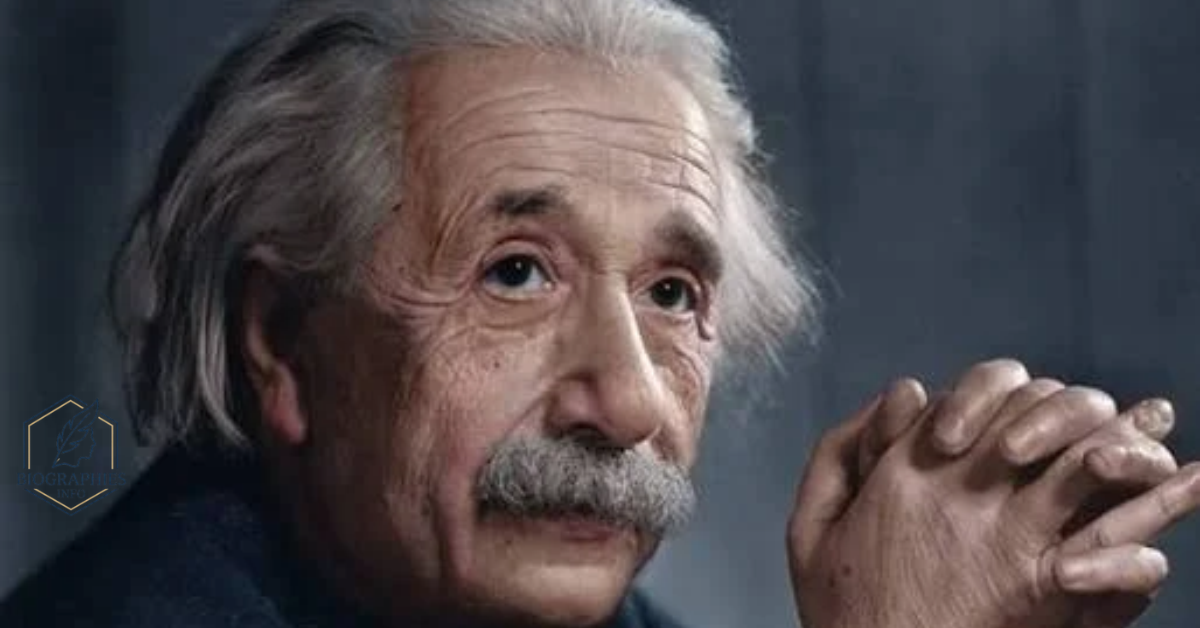
Albert Einstein Biography tells the remarkable story of a theoretical physicist whose groundbreaking ideas transformed our understanding of space, time, light, gravity, and energy. But his story goes far beyond the image of a brilliant genius.
This fascinating biography explores Einstein’s early life, education, struggles, marriages, children, revolutionary discoveries, famous quotes, and final years. It also uncovers his work at a patent office, his Miracle Year breakthroughs, his views on the atomic bomb, and his dramatic departure from Nazi Germany.
From academic disappointment to becoming one of the most influential scientists in history, Einstein’s extraordinary journey shows the power of curiosity, independent thinking, and persistence
Quick Facts
Before diving into the full story, here is a snapshot of Albert Einstein whole life
| Category | Detail |
|---|---|
| Full Name | Albert Einstein |
| Born | March 14, 1879 Ulm, Kingdom of Württemberg, German Empire |
| Died | April 18, 1955 (aged 76) Princeton, New Jersey, USA |
| Cause of Death | Ruptured abdominal aortic aneurysm (internal bleeding) |
| Nationality | German, Swiss, Austrian, and later American citizen |
| Married | Mileva Marić (1903–1919) and Elsa Einstein (1919–1936) |
| Children | Lieserl, Hans Albert, and Eduard |
| Education | Swiss Federal Polytechnic School, Zurich |
| Famous For | Theory of Relativity and the equation E = mc² |
| Major Award | Nobel Prize in Physics, 1921 (awarded 1922) |
| Longtime Workplace | Institute for Advanced Study, Princeton (1933–1955) |
Who Was Albert Einstein?
Albert Einstein was a German born theoretical physicist widely regarded as the most influential scientist of the twentieth century. Born in 1879 in Ulm, Germany, he developed the special and general theories of relativity, reshaping how humanity understands space, time, and gravity.
In 1921, he won the Nobel Prize in Physics for explaining the photoelectric effect, a discovery that helped launch quantum theory. His equation E = mc² became the most famous formula in science.
Beyond physics, Einstein was a vocal humanitarian, pacifist, and advocate for civil rights. He fled Nazi Germany in 1933, settled in Princeton, New Jersey, and became a U.S. citizen in 1940. He died in 1955, leaving behind a legacy that still drives modern GPS technology, lasers, and space science.
Albert Einstein’s Early Life and Education
Long before he reshaped physics, Einstein was a curious, unconventional child who clashed with strict schooling. Here is how his formative years unfolded.
Childhood in Munich
Albert Einstein was born on March 14, 1879, in Ulm, Germany, to Hermann and Pauline Einstein. The family relocated to Munich just six weeks later.Contrary to popular myth, young Einstein was not a poor student.
He simply learned to speak later than most children and disliked the rigid, rote-learning style enforced at his grammar school. At age five, his father gave him a pocket compass, and the mysterious force moving its needle sparked a lifelong fascination with the invisible laws of nature.
Education Journey
Einstein’s formal education took several unconventional turns before he found his footing:
- Luitpold Gymnasium, Munich : left without graduating due to conflicts with authoritarian teaching methods.
- Aarau Cantonal School, Switzerland : completed his final schooling and earned his Matura in 1896.
- Swiss Federal Polytechnic School, Zurich : graduated in 1900 with a teaching diploma in mathematics and physics.
He struggled to find an academic post after graduation and instead took a job as a technical assistant at the Swiss Patent Office in Bern, a decision that quietly changed the course of science.
Personal Life: Marriages and Children
Einstein’s personal life was as complex as his equations. He married twice, raised three children, and navigated family strain even as his public fame grew.
First Marriage with Mileva Marić
Einstein married his university classmate Mileva Marić in 1903. The couple had already welcomed a daughter, Lieserl, in 1902, before marrying; her fate afterward remains historically uncertain.
The marriage produced two more children but grew strained under the pressure of Einstein’s rising fame and long absences. The couple divorced in 1919.
Second Marriage with Elsa Einstein
The same year, Einstein married his cousin Elsa Löwenthal, who supported him through his most publicly demanding years, including the move to the United States. She passed away in 1936.
Here is a clear breakdown of Einstein’s immediate family:
| Name | Relationship | Key Detail |
|---|---|---|
| Lieserl Einstein | Daughter (with Mileva) | Born 1902; historical records after early childhood are unclear |
| Hans Albert Einstein | Son (with Mileva) | Born 1904; became a respected hydraulic engineering professor |
| Eduard Einstein | Son (with Mileva) | Born 1910; diagnosed with schizophrenia in early adulthood |
| Mileva Marić | First wife | Married 1903, divorced 1919; a trained physicist herself |
| Elsa Einstein | Second wife | Married 1919; died 1936 |
Einstein’s Personal Quirks and Daily Habits
Behind the equations was a genuinely eccentric, absent-minded man whose daily habits have become almost as famous as his physics.
- Sleep routine he reportedly needed around 10 hours of sleep a night, plus regular daytime naps.
- The pencil trick he held a pencil or spoon while napping, so dropping it upon dozing off would wake him to capture half-dreamed ideas.
- No socks, ever he found them impractical and disliked the hole his big toe eventually wore through them.
- The violin he played from childhood and said he often thought through problems in music rather than words.
- Forgetfulness colleagues recalled him losing keys, forgetting addresses, and once leaving a suitcase behind entirely.
His most iconic image tongue stuck out at photographers on his 72nd birthday in 1951 captured this same playful, unbothered personality perfectly.
Career and the Miracle Year
Einstein’s rise from an overlooked graduate to a world-changing physicist happened faster than most people realize and it started in an unlikely government office.
The Swiss Patent Office Job
Working at the patent office gave Einstein something rare: free thinking time. Reviewing technical applications sharpened his ability to visualize complex mechanical and physical problems quickly.
1905: The Miracle Year (Annus Mirabilis)
In a single extraordinary year, Einstein published four groundbreaking papers that transformed physics forever. Each paper alone would have made most scientists famous.
- Photoelectric Effect: proved light behaves as discrete particles (quanta), later called photons.
- Brownian Motion: offered experimental proof that atoms and molecules genuinely exist.
- Special Relativity: introduced the idea that time and space are relative, not absolute.
- Mass-Energy Equivalence : produced the world-famous equation E = mc².
A decade later, in 1915, he extended these ideas into the General Theory of Relativity, describing gravity as the curving of space-time itself, a theory later confirmed by observing starlight bending during a solar eclipse. Einstein’s theories later became an important foundation for scientists such as Stephen Hawking, who explored black holes and the nature of the universe.
Major Albert Einstein Inventions and Discoveries
People often search for Albert Einstein inventions expecting gadgets, but his real inventions were ideas that unlocked entire industries. Here is what he actually pioneered:
- General & Special Relativity: the foundation of modern cosmology and space-time physics.
- Photoelectric Effect: the working principle behind solar panels and digital cameras.
- Bose-Einstein Statistics: developed with Satyendra Nath Bose, laying groundwork for lasers.
- Einstein Refrigerator: co-designed with Leo Szilard, patent filed in 1926 and granted in 1930, requiring no moving parts.
- Gravitational Lensing Concept :predicted light bending around massive objects, now used to detect exoplanets.
Modern technologies like GPS navigation, satellite communication, and MRI scanning all rely on corrections derived from Einstein’s relativity equations.
What Was Albert Einstein Famous For?
Ask anyone what Einstein is famous for, and most will say relativity or E = mc². But his fame spans several distinct achievements:
- Revolutionizing physics with the theories of special and general relativity
- Winning the 1921 Nobel Prize in Physics for the photoelectric effect
- Becoming a global symbol of genius and unconventional thinking
- Championing civil rights, pacifism, and nuclear disarmament
- Declining the presidency of Israel in 1952, choosing science over politics
Einstein and the Atomic Bomb
Einstein never worked on the atomic bomb directly, yet his name remains permanently linked to its creation. Understanding his actual role clears up one of the biggest myths about his legacy.
The 1939 Warning Letter
In August 1939, Einstein co-signed a letter largely drafted by physicist Leo Szilard warning President Franklin D. Roosevelt that Nazi Germany could be developing nuclear weapons.
A decade later, in 1915, he extended these ideas into the General Theory of Relativity, describing gravity as the curving of space-time itself, a theory later confirmed by observing starlight bending during a solar eclipse.
Why He Was Kept Off the Project
Despite sounding the alarm, Einstein was denied security clearance in 1940 by U.S. Army Intelligence, due to his pacifist views and past socialist affiliations. J. Robert Oppenheimer and the Los Alamos team were barred from consulting him.
His Regret and Later Activism
Einstein had no advance knowledge that the bomb would be used on Japan. On hearing of the Hiroshima bombing, he reportedly responded with dismay, saying the world was not ready for such a weapon.
- 1946 — co-founded the Emergency Committee of Atomic Scientists to promote peaceful nuclear policy.
- 1947 — wrote for The Atlantic Monthly, urging United Nations oversight of nuclear weapons.
- 1955 — signed the Russell-Einstein Manifesto days before his death, calling for global nuclear disarmament.
The Travel Diaries Controversy
In 2018, Princeton University Press published Einstein’s personal travel diaries from a 1922–1923 world tour through Asia and the Middle East, revealing a far less flattering side of him.
Alongside his scientific observations, the diaries contained private remarks about the people he encountered that historians and readers have widely described as xenophobic and demeaning, particularly toward communities in China and Sri Lanka.
The revelations created a stark contrast with Einstein, a man who later became a vocal civil rights advocate, joined the NAACP, and called racism America’s worst disease.
Historians generally frame the diaries as unfiltered private notes never intended for publication, rather than formal statements of belief. Even so, the discovery pushed biographers to present a more complete, less idealized picture of him.
What Does E = mc² Mean?
The equation E = mc² expresses the equivalence of mass and energy. In simple terms, it shows that mass can be understood as a concentrated form of energy, with the speed of light squared acting as the conversion factor.
Although the equation is now one of the world’s most recognizable scientific formulas, it represents only one part of Einstein’s work. His wider contribution to physics included relativity, statistical physics and important debates about quantum theory.
General Theory of Relativity
Einstein’s general theory of relativity, completed in 1915, offered a revolutionary description of gravity. Instead of treating gravity simply as an ordinary force, the theory describes how matter and energy affect the geometry of spacetime.
The theory later became essential to modern work on black holes, cosmology and gravitational waves. It also has practical relevance: modern navigation systems such as GPS require relativistic corrections to maintain accurate timing.
The 1919 Eclipse and Einstein’s Rise to Global Fame
Observations made during the 1919 solar eclipse were used to test Einstein’s prediction concerning the bending of starlight by gravity. The results received enormous international attention and helped transform Einstein into a global celebrity.
This was the moment when Einstein’s scientific reputation moved into popular culture. Newspapers, lectures and photographs turned the physicist into an international public figure.
Albert Einstein’s Brain: The Scientific Mystery
After his death, pathologist Thomas Harvey removed and preserved Einstein’s brain without full family permission, sparking decades of scientific and ethical debate.
A 1985 study by researcher Marian Diamond reported an above-average glial-cell ratio in one brain region, and later work noted unusual folding in the parietal lobe, an area linked to spatial and mathematical reasoning.
These findings remain scientifically disputed; the original sample size was small, and most neuroscientists caution that a single brain cannot prove structure alone explains genius.
How Did Albert Einstein Die?
Albert Einstein died on April 18, 1955, in Princeton, New Jersey, from internal bleeding caused by a ruptured abdominal aortic aneurysm.He had refused surgery years earlier, reportedly saying he wanted to leave when it was his time, in his own way, rather than artificially extend his life.
He was 76 years old. His remains were cremated, and his ashes were scattered at an undisclosed location, honoring his wish to avoid becoming a public shrine.
10 Verified Albert Einstein Quotes
Many quotes online are wrongly attributed to Einstein. The 10 lines below are well-documented, traced to his letters, interviews, or published writings.
- “Imagination is more important than knowledge.” Saturday Evening Post interview, 1929
- “Life is like riding a bicycle. To keep your balance, you must keep moving.” letter to his son Eduard, 1930
- “The important thing is not to stop questioning. Curiosity has its own reason for existing.” LIFE magazine, 1955
- “Anyone who has never made a mistake has never tried anything new.” widely documented in his later correspondence
- “In the middle of difficulty lies opportunity.” frequently cited personal maxim
- “Great spirits have always encountered violent opposition from mediocre minds.” letter to Morris Raphael Cohen, 1940
- “Try not to become a man of success, but rather try to become a man of value.” LIFE magazine, 1955
- “I have no special talents. I am only passionately curious.” letter to Carl Seelig, 1952
- “It’s not that I’m so smart, it’s just that I stay with problems longer.” commonly cited by biographer
- “Peace cannot be kept by force; it can only be achieved by understanding.” from his writings on pacifism, 1930s
Albert Einstein Timeline: Key Dates and Milestones
Here is the definitive Einstein timeline from birth to legacy:
| Year | Milestone |
|---|---|
| 1879 | Born on March 14 in Ulm, Germany |
| 1896 | Enters the Swiss Federal Polytechnic School in Zurich |
| 1900 | Graduates with a teaching diploma in physics and mathematics |
| 1902 | Begins work at the Swiss Patent Office in Bern |
| 1903 | Marries Mileva Marić |
| 1905 | Publishes four landmark papers, including special relativity |
| 1915 | Completes the General Theory of Relativity |
| 1919 | Divorces Mileva; solar eclipse observation confirms relativity |
| 1921 | Wins the Nobel Prize in Physics for the photoelectric effect |
| 1933 | Emigrates to the United States, fleeing Nazi persecution |
| 1940 | Becomes a United States citizen |
| 1952 | Declines the offer to become President of Israel |
| 1955 | Dies on April 18 in Princeton, New Jersey |
Awards, Honors and Lasting Legacy
- Nobel Prize in Physics (1921) for the discovery of the law of the photoelectric effect.
- Copley Medal (1925) awarded by the Royal Society for his contributions to physics.
- TIME Person of the Century (1999) recognized for shaping twentieth-century science and thought.
- Einstein Ring & Gravitational Lensing phenomena named after him and used in modern astronomy.
- Global Cultural Icon his name and image remain synonymous with genius worldwide.
Albert Einstein in Film and Pop Culture
Few scientists have been dramatized on screen as often as Einstein, with portrayals ranging from serious biographical drama to broad comedy.
- Genius (2017) National Geographic’s 10-part miniseries starring Geoffrey Rush as the older Einstein and Johnny Flynn as his younger self, widely praised for historical accuracy.
- Oppenheimer (2023) Tom Conti played Einstein in Christopher Nolan’s Oscar-winning film about the Manhattan Project.
- I.Q. (1994) a romantic comedy in which Walter Matthau played Einstein as a matchmaking uncle figure.
- Young Einstein (1988) an Australian comedy loosely, and fictionally, reimagining his early life.
His estate and image rights are managed by the Hebrew University of Jerusalem, meaning his likeness still appears in licensed advertising, merchandise, and media worldwide, a rare afterlife for a 20th-century scientist.
Did Albert Einstein Really Fail Math?
No. The famous story that Einstein failed mathematics is misleading. His academic record shows strong ability in mathematics and physics. The more accurate story is that he disliked certain school methods and initially struggled with parts of the entrance examination for the Zurich Polytechnic.
Final Thoughts
Albert Einstein’s story proves that curiosity outperforms conformity. A boy once dismissed by teachers became the scientist who redefined how humanity understands the universe.
From the patent office in Bern to the Nobel stage in Stockholm, his journey remains one of the most inspiring case studies in perseverance, imagination, and independent thought.
Frequently Asked Questions
What is the best biography of Albert Einstein?
Many readers consider Walter Isaacson’s “Einstein: His Life and Universe” the most comprehensive modern biography, praised for balancing his scientific work with his personal struggles.
What are some biographies of Albert Einstein?
Notable options include Isaacson’s biography, Abraham Pais’s “Subtle is the Lord,” and Jürgen Neffe’s “Einstein: A Biography,” each offering a different angle on his life and legacy.
Does Einstein have a biopic?
Yes. Einstein’s life has inspired documentaries and dramatizations, most notably the National Geographic series “Genius,” which portrays his personal and scientific journey in detail.
How many wives did Einstein have?
Einstein married twice: first to Mileva Marić in 1903, and later to his cousin Elsa Einstein in 1919, after his divorce from Mileva.
Why is Einstein’s brain still studied today?
Researchers continue examining preserved slides and photographs of his brain to understand possible links between brain structure and exceptional cognitive ability, though conclusions remain debated.
What made Einstein’s 1905 papers so important?
These four papers individually reshaped how scientists understood light, atoms, motion, and energy, collectively launching modern theoretical physics within a single year.
Did Einstein help build the atomic bomb?
No. He co-signed a 1939 warning letter to President Roosevelt about German nuclear research, but he was denied security clearance and never worked on the Manhattan Project itself.