
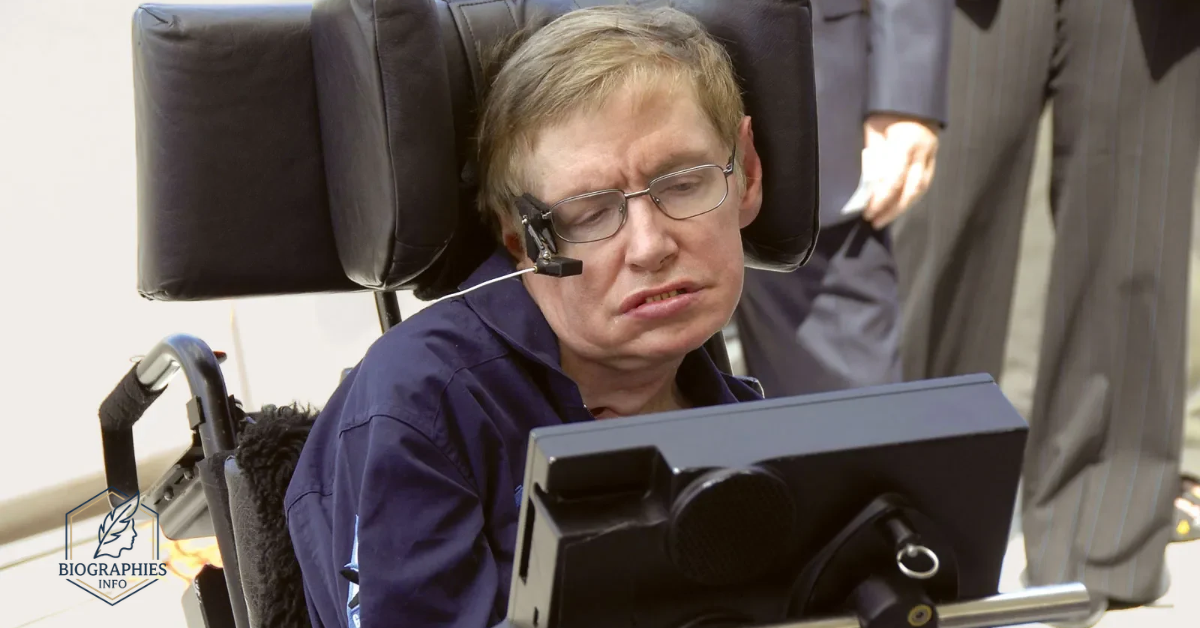
Stephen Hawking remains one of the most inspiring figures in modern history, a theoretical physicist who rewrote our understanding of black holes, survived a devastating diagnosis for over 55 years, and turned complex cosmology into bestselling books that millions still read today.
Discover Stephen Hawking’s extraordinary journey from his birth, education, marriages, children, and disease to his net worth, death, and famous quotes in this comprehensive, easy to read BiographiesInfo guide.
Stephen Hawking Quick Facts
Here is a fast, scannable snapshot of his life before we dive deeper.
| Full Name | Stephen William Hawking |
| Born | 8 January 1942, Oxford, England |
| Died | 14 March 2018 (aged 76), Cambridge, England |
| Nationality | British |
| Occupation | Theoretical physicist, cosmologist, author |
| Famous For | Hawking radiation, black hole research, A Brief History of Time |
| Education | University College, Oxford; Trinity Hall, Cambridge (PhD) |
| Married | Twice – Jane Wilde (1965–1995) and Elaine Mason (1995–2006) |
| Children | Robert, Lucy, and Timothy Hawking |
| Disease | Amyotrophic Lateral Sclerosis (ALS / motor neurone disease), diagnosed at 21 |
| Net Worth | Approximately $20 million (about £16.3 million) at the time of death |
| Famous Book | A Brief History of Time (1988) |
| Cause of Death | Complications related to ALS |
Who Was Stephen Hawking?
Stephen Hawking was a British theoretical physicist and cosmologist who served as Director of Research at Cambridge’s Centre for Theoretical Cosmology. Between 1979 and 2009 he held the Lucasian Professorship of Mathematics, the same chair once occupied by Sir Isaac Newton.
Diagnosed with a rare, early-onset form of Amyotrophic Lateral Sclerosis (ALS) at just 21 years old, doctors gave him only a couple of years to live. He instead defied every prediction, living for more than five decades and becoming a global icon of resilience and intellect.
Early Life and Family Background
Stephen Hawking was born into a highly educated family that valued science, education, and intellectual curiosity. He was born on 8 January 1942 in Oxford, England, and spent his early childhood there.
His father, Dr. Frank Hawking, was a research biologist specialising in tropical medicine, while his mother, Isobel Hawking, had studied Philosophy, Politics, and Economics at Oxford. Stephen was the eldest of four children, with two younger sisters and an adopted brother.
School Days at St Albans
The family later moved to St Albans, Hertfordshire, where young Stephen attended St Albans School.
- Not a top student: he admitted that he was never one of the top students in his class.
- Nicknamed “Einstein” by classmates who spotted his hidden brilliance early.
- Loved building board games, model aircraft, and taking things apart to see how they worked.
Education Journey
Stephen Hawking showed a strong interest in science and mathematics from an early age. His academic journey took him from Oxford to Cambridge, where he developed the foundation for his remarkable work in cosmology and theoretical physics.
University College, Oxford
In 1959, at just 17 years old, Hawking began studying Natural Sciences at University College, Oxford, a compromise between his own wish to study mathematics and his father’s push toward medicine. He graduated in 1962 with a firs-tclass honours degree in physics..
Cambridge University and PhD
Hawking then moved to Trinity Hall, Cambridge, to pursue graduate research in cosmology and general relativity, earning his PhD in 1966. It was during this period, in 1963, that everything changed.
Personal Life: Marriages and Children
Beyond his remarkable scientific work, Stephen Hawking also experienced important milestones in his personal life. His marriages, family relationships, and children remained an important part of his life throughout his journey.
First Marriage to Jane Wilde
Hawking met Jane Wilde shortly before his diagnosis, and the couple married in 1965. Jane’s support became central to his early survival and career.
The marriage lasted 25 years before the couple separated in 1990 and formally divorced in 1995.
Second Marriage to Elaine Mason
In 1995, Hawking married Elaine Mason, one of his former nurses. This marriage ended in divorce in 2006, after which Hawking rebuilt close ties with Jane and their children.
Children and Grandchildren
Stephen and Jane Hawking had three children: Robert (a software engineer), Lucy (an author and journalist), and Timothy. He was also survived by three grandchildren.
The ALS Diagnosis That Changed Everything
At the beginning of his twenties, Stephen Hawking’s life took an unexpected turn. The health problems he experienced during this period led to a diagnosis that would dramatically change his personal life and future career.
Symptoms and Diagnosis at 21
While at Oxford, Hawking noticed increasing clumsiness stumbling on stairs and struggling while rowing. At age 21, he was diagnosed with amyotrophic lateral sclerosis (ALS), also called motor neurone disease or Lou Gehrig’s disease. Doctors expected he would live only two to three more years.
Fighting the Odds
Hawking instead outlived his prognosis by more than 50 years, eventually becoming almost completely paralysed.
- 1985: lost his voice permanently after an emergency tracheotomy.
- Communicated using a cheek muscle sensor linked to a speech synthesiser.
- Could produce roughly 15 words per minute using this system.
- Continued lecturing, writing, and researching until his final days.
Career and Scientific Achievements
Stephen Hawking made remarkable contributions to modern physics and cosmology throughout his career. His deep research on black holes and his ability to explain complex scientific ideas to the public made him great scientist. Stephen Hawking became one of the most influential scientific thinkers of the modern era.
Black Holes and Hawking Radiation
Hawking’s most celebrated breakthrough came in 1974, when he proposed that black holes are not entirely black: they emit particles until they eventually evaporate.This discovery, now known worldwide as Hawking radiation, merged quantum mechanics with general relativity for the first time.
Earlier, alongside physicist Roger Penrose, he developed influential singularity theorems describing the birth of the universe.
A Brief History of Time and Other Books
In 1988, Hawking published A Brief History of Time, a book that translated cosmology for everyday readers and stayed on bestseller lists for a record 237 weeks.
- A Brief History of Time (1988) his defining bestseller.
- The Universe in a Nutshell (2001).
- A Briefer History of Time (2005).
- My Brief History (2013) his personal memoir.
- Brief Answers to the Big Questions (2018) published posthumously.
Lucasian Professor of Mathematics
Hawking held Cambridge’s most prestigious mathematics chair from 1979 to 2009, a role once filled by Sir Isaac Newton and later by Paul Dirac.
Did Stephen Hawking Believe in God?
Hawking did not believe in a personal God and identified as an atheist in his later years. He argued that the universe could arise from the laws of physics alone, without needing a divine “first cause,” a view he explored in depth in A Brief History of Time and The Grand Design.
Major Awards and Honours
Hawking’s Revolutionary contributions earned him some of science’s highest honours.
| Year | Award / Honour |
|---|---|
| 1974 | Fellow of the Royal Society |
| 1975 | Eddington Medal |
| 1982 | Commander of the Order of the British Empire (CBE) |
| 1985 | Gold Medal, Royal Astronomical Society |
| 1989 | Companion of Honour |
| 2006 | Copley Medal, Royal Society |
| 2009 | US Presidential Medal of Freedom |
Stephen Hawking in Movies and Popular Culture
Hawking became more than an academic celebrity. He appeared as himself or lent his voice to major television and entertainment projects, including Star Trek: The Next Generation, The Simpsons, Futurama and The Big Bang Theory.
His life inspired the 2014 film The Theory of Everything, based on Jane Hawking’s memoir. The film introduced his early relationship, illness, scientific career and family story to a new generation.
Hawking also became a powerful public symbol of scientific curiosity, disability and perseverance.
Stephen Hawking Net Worth
At the time of his death, Stephen Hawking’s net worth stood at roughly $20 million (about £16.3 million).
His fortune came mainly from book royalties, his Cambridge research role, speaking engagements, media appearances, and prize money from major scientific awards.
- Books–A Brief History of Time alone sold over 10 million copies worldwide.
- Academic salary– his Cambridge research directorship reportedly paid several million dollars across his career.
- Media and film– royalties tied to The Theory of Everything (2014) and TV appearances.
- His estate was left mainly to his three children and three grandchildren via a trust fund.
Famous Quotes by Stephen Hawking
Hawking was as famous for his sharp wit as for his science. Some of his most powerful quotes include:
“Intelligence is the ability to adapt to change.”
“Look up at the stars and not down at your feet.”
“People who boast about their IQ are losers.”
“However difficult life may seem, there is always something you can do.”
“I try to lead as normal a life as possible, and not think about my condition.”
Death and Legacy
Stephen Hawking’s death marked the end of an extraordinary life that inspired millions around the world. His scientific discoveries, books, and determination continue to influence science and popular culture today.
How Did Stephen Hawking Die?
Stephen Hawking died peacefully at his home in Cambridge on 14 March 2018, at the age of 76, from complications related to ALS.
Strikingly, his death fell on Pi Day, an annual celebration of the mathematical constant π (pi), observed on 14 March (3/14), and on the birthday of Albert Einstein.
Legacy and Influence
Hawking’s ashes were interred at Westminster Abbey, between the graves of Isaac Newton and Charles Darwin.
In the years following his death, his estate reportedly earned over $100 million from continued book sales and licensing, cementing his status as one of the most influential scientific communicators in history.
Why Stephen Hawking Did Not Win a Nobel Prize
Hawking’s scientific reputation was enormous, but he never received the Nobel Prize in Physics. One important reason is that his most famous prediction, Hawking radiation, has been difficult to confirm directly through astronomical observation.
The Hawking estate notes that the lack of experimental confirmation was a major obstacle. That does not reduce the theoretical importance of his work, but Nobel recognition generally depends on discoveries that can be sufficiently established through evidence.
Stephen Hawking Timeline
| Year | Milestone |
|---|---|
| 1942 | Born in Oxford, England |
| 1959 | Begins studies at University College, Oxford |
| 1963 | Diagnosed with ALS at age 21 |
| 1965 | Marries Jane Wilde; begins PhD at Cambridge |
| 1974 | Proposes Hawking radiation theory |
| 1979 | Appointed Lucasian Professor of Mathematics |
| 1985 | Loses voice; begins using a speech synthesiser |
| 1988 | Publishes A Brief History of Time |
| 1995 | Divorces Jane; marries Elaine Mason |
| 2006 | Divorces Elaine Mason |
| 2009 | Retires as Lucasian Professor; awarded Presidential Medal of Freedom |
| 2014 | The Theory of Everything film released |
| 2018 | Dies in Cambridge on 14 March, aged 76 |
Frequently Asked Questions
Who is Stephen Hawking in a short biography?
Stephen Hawking (1942–2018) was a British theoretical physicist and cosmologist famous for his work on black holes and Hawking radiation, and for his bestselling book A Brief History of Time. He lived with ALS for over 55 years while continuing groundbreaking research.
How many times did Stephen Hawking marry?
Hawking married twice: first to Jane Wilde in 1965 (divorced 1995), and then to Elaine Mason in 1995 (divorced 2006).
Did Stephen Hawking believe in God?
No. Hawking was an atheist who believed the universe could be explained through physics alone, without requiring a divine creator.
What are 10 facts about Stephen Hawking?
- Born on the 300th anniversary of Galileo’s death.
- Diagnosed with ALS at age 21.
- Held the Lucasian Professorship once held by Isaac Newton.
- Proposed Hawking radiation in 1974.
- A Brief History of Time sold over 10 million copies.
- Married twice and had three children.
- Communicated using a cheek-controlled speech synthesiser.
- Received the US Presidential Medal of Freedom in 2009.
- His life inspired the film The Theory of Everything (2014).
- Died on 14 March 2018, the same day as Einstein’s birthday.
What was Stephen Hawking’s disease?
He had amyotrophic lateral sclerosis (ALS), a rare, early-onset, slow-progressing motor neurone disease that gradually paralysed his body over decades.
Who was Stephen Hawking’s wife?
His first wife was Jane Wilde Hawking, and his second wife was Elaine Mason.
What is Stephen Hawking famous for?
He is famous for his theory of Hawking radiation, his research on black holes and the origin of the universe, and his bestselling book A Brief History of Time.
Is there a Stephen Hawking biography movie?
Yes, The Theory of Everything (2014), starring Eddie Redmayne, is based on Jane Hawking’s memoir about their marriage and won an Academy Award.
Final Thoughts
Stephen Hawking’s life was a remarkable journey of curiosity, courage, and determination. Despite being diagnosed with ALS at just 21 and given only a few years to live, he went on to spend more than five decades exploring the mysteries of the universe and inspiring millions around the world.
From his groundbreaking work on black holes to his bestselling books, Hawking showed that physical limitations could not stop the power of the human mind. His legacy continues through his scientific discoveries, ideas, and the generations of people he inspired to look beyond the ordinary and question the universe around them.