
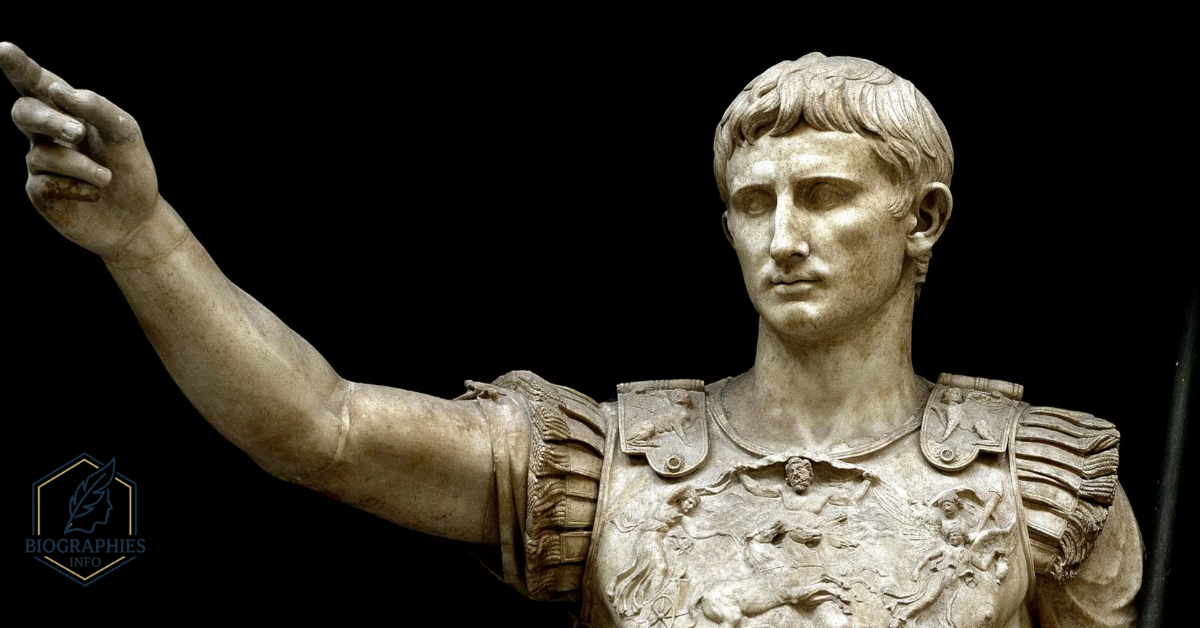
The Augustus Caesar biography tells the remarkable story of a young heir who rose to become Rome’s first emperor. Discover his childhood, rise to power, military successes, family, wealth, political reforms, death, and the enduring legacy that shaped one of history’s greatest civilizations.
Quick Facts: Augustus Caesar at a Glance
Here’s a fast, scannable snapshot of the key facts which include birth, death, marriage, children, and net worth.
| Quick Fact | Detail |
|---|---|
| Full Name | Gaius Octavius (born); Gaius Julius Caesar Octavianus (adopted); Imperator Caesar Augustus (as emperor) |
| Also Known As | Augustus Caesar, Octavian |
| Father | Gaius Octavius (biological); Julius Caesar (adoptive father, per Caesar’s will) |
| Born | 23 September 63 BC – Rome, Roman Republic |
| Died | 19 August AD 14 (aged 75) – Nola, Italy |
| Cause of Death | Natural causes brought on by old age and illness; ancient writers floated an unproven poisoning theory involving his wife, Livia |
| Married | Three times — Claudia (Clodia Pulchra), then Scribonia, then Livia Drusilla (his lifelong wife of 52 years) |
| Children | One biological daughter, Julia the Elder (with Scribonia); no biological sons |
| Religion | Roman polytheism; officially declared a god (Divus Augustus) by the Senate after his death |
| Title | First Emperor of Rome (Principate founder), ruled 27 BC – AD 14 |
| Height | Around 5 ft 7 in (170 cm), per Suetonius’s description |
| Net Worth (estimated) | Historians’ modern estimates run as high as $4.6–$5.8 trillion in today’s money — among the largest personal fortunes ever, though the figure is contested |
Who Was Augustus Caesar?
Augustus Caesar, born Gaius Octavius, was the founder and first emperor of the Roman Empire, ruling from 27 BC until his death in AD 14. He transformed a war-torn Roman Republic into a stable empire and launched the Pax Romana, roughly two centuries of relative peace and prosperity across the Roman world.
His journey from an 18-year-old grandnephew of Julius Caesar to the most powerful man in the ancient world remains one of history’s greatest political comebacks.
Augustus Caesar’s Early Life and Childhood
Family Background
Octavius was born on 23 September 63 BC in Rome to a wealthy plebeian family. His great-uncle was none other than Julius Caesar, the Roman dictator whose assassination would change the course of his great-nephew’s life forever.
Adoption by Julius Caesar
When Julius Caesar was assassinated by senators in 44 BC, his will revealed a shock: 18-year-old Octavius was named as his adopted son and principal heir, inheriting Caesar’s name, fortune, and the loyalty of his veteran legions.
A year earlier, in 47 BC, Octavius had already proven his loyalty in dramatic fashion: while traveling to join Caesar’s campaign in Hispania, he was shipwrecked and had to cross hostile territory alone to reach his great-uncle an act of grit that reportedly impressed Caesar enough to help cement his choice of heir.
- He was only 18 years old when he inherited Caesar’s name and estate.
- He immediately claimed the name Gaius Julius Caesar, invoking his adoptive father’s legacy.
- This inheritance placed him directly in the middle of Rome’s deadliest power struggle.
Augustus Caesar and Julius Caesar: What Was Their Relationship?
Many people wonder about the relationship between Augustus Caesar and Julius Caesar. Although they shared the famous Caesar name, they were not father and son.
Although Augustus built on Julius Caesar’s legacy, the two leaders played very different roles in Roman history. Their paths to power, styles of leadership, and lasting impact shaped Rome in unique ways. The comparison below highlights the key differences at a glance.
| Point of Comparison | Detail |
|---|---|
| Relationship | Great-nephew and adopted son of Julius Caesar |
| Title Held | Caesar was a dictator of the Republic; Augustus became the first Emperor of Rome |
| Rise to Power | Caesar seized power through military conquest and civil war; Augustus inherited Caesar’s name and legions, then out-maneuvered rivals politically and militarily |
| Death | Caesar was assassinated by senators in 44 BC; Augustus died of natural causes at 75 |
| Legacy | Caesar ended the Republic in practice; Augustus formally founded the Roman Empire and the Pax Romana |
Augustus Caesar’s Personal Life
Marriages
Augustus married three times. His first marriage to Clodia Pulchra was never consummated. His second wife, Scribonia, gave him his only biological child. He then divorced her to marry Livia Drusilla, who remained his wife for 52 years until his death.
Children
Augustus had only one biological child, a daughter named Julia the Elder, born to Scribonia. With no biological son to succeed him, he adopted his stepson Tiberius, Livia’s son from her first marriage, as his heir.
Religion
Augustus practiced traditional Roman polytheism and actively promoted religious revival across the empire. After his death, the Senate officially declared him a god, Divus Augustus, cementing the tradition of emperor worship that followed.
Physical Appearance and Personality
Ancient sources describe Augustus as of only average height, reportedly wearing lifts in his sandals to appear taller, with fair hair, bright eyes, and a calm, composed expression. He was temperate in his habits, eating lightly and drinking little, though he battled recurring illness throughout his life. He enforced strict moral legislation on Roman society, going so far as to exile his own daughter, Julia the Elder, for her public affairs, a striking contrast to his own reputation for personal relationships outside his marriage.
Augustus Caesar’s Rise to Power
The Second Triumvirate
Octavian formed the Second Triumvirate with Mark Antony and Marcus Lepidus to hunt down Julius Caesar’s assassins, defeating them decisively at the Battle of Philippi in 42 BC.
The Battle of Actium
The alliance eventually collapsed into civil war. In 31 BC, Octavian’s forces crushed the combined fleet of Mark Antony and Cleopatra at the Battle of Actium, leaving him the unrivaled master of Rome.
Becoming Augustus
In 27 BC, the Senate granted Octavian the title “Augustus” (meaning “the revered” or “exalted one”), marking the formal birth of the Roman Empire and the end of the centuries-old Republic in all but name.
Augustus and Cleopatra: The Rivalry That Sealed His Power
Before she was Mark Antony’s lover, Cleopatra was a formidable monarch in her own right Greek by heritage through Egypt’s Ptolemaic dynasty, fluent in Greek, yet deliberately versed in Egyptian language and religion to strengthen her rule. She had allied with Julius Caesar to reclaim her throne, then turned to Antony after Caesar’s death.
When Antony had children with Cleopatra and publicly recognized her son Caesarion as Julius Caesar’s true heir, he directly challenged Octavian’s own claim to the Caesar legacy. Octavian framed the conflict as Rome against a foreign queen, rallying support before crushing their fleet at Actium. Cleopatra’s death by suicide in 30 BC, reportedly from snakebite, closed the door on Egypt’s Ptolemaic era and cleared Octavian’s final path to sole power.
Augustus Caesar’s Many Names and Titles Explained
Few historical figures changed names as strategically as Augustus. Each name marked a distinct phase of his rise:
- Gaius Octavius Thurinus his birth name, before any connection to Julius Caesar’s power.
- Octavian is the name historians use for the period between Caesar’s assassination in 44 BC and 27 BC, after he claimed Caesar’s name and inheritance.
- Imperator Caesar adopted around 38 BC, replacing his given name with the victory title “imperator” (commander).
- Augustus granted it by the Senate in 27 BC, meaning “the revered one,” marking the formal start of his reign as emperor.
- Pater Patriae “father of the country,” an honorific title bestowed by the Senate in 2 BC near the end of his reign.
This naming strategy was itself political; each new title reinforced his legitimacy while carefully avoiding titles like “king” or “dictator” that Romans associated with tyranny.
Augustus Caesar Timeline
| Year | Event |
|---|---|
| 63 BCE | Born Gaius Octavius in Rome |
| 44 BCE | Julius Caesar assassinated; Octavian named heir in his will |
| 43 BCE | Formation of the Second Triumvirate (Octavian, Mark Antony, Lepidus) |
| 42 BCE | Battle of Philippi defeats Caesar’s assassins, Brutus and Cassius |
| 36 BCE | Lepidus removed from the Triumvirate; Octavian consolidates power in the West |
| 31 BCE | Battle of Actium — Octavian defeats Mark Antony and Cleopatra |
| 30 BCE | Egypt annexed as a Roman province; Antony and Cleopatra die |
| 27 BCE | Octavian granted the title “Augustus” by the Senate; Roman Empire effectively begins |
| 23 BCE | Augustus granted tribunician power for life, cementing legal authority |
| 19 BCE | Virgil’s Aeneid completed (posthumously published), celebrating Rome’s founding myth |
| 12 BCE | Augustus becomes Pontifex Maximus (chief priest of Rome) |
| 2 BCE | Given the title Pater Patriae (“Father of the Country”) |
| 9 CE | Roman defeat at the Battle of Teutoburg Forest halts expansion into Germania |
| 14 CE | Augustus dies; succeeded by his stepson Tiberius |
Military Campaigns and Territorial Expansion
Over his 40-year reign, Augustus nearly doubled the size of the Roman Empire, extending Roman influence and alliances from Britain to India. His expansion, though not without setbacks, included:
- Annexed Egypt as his personal province after defeating Antony and Cleopatra in 30 BC.
- Completed the conquest of Hispania (modern Spain and Portugal).
- Expanded Roman control into the Alpine regions of Raetia and Noricum, and into Illyricum and Pannonia.
- Extended Africa Proconsularis and negotiated the peaceful return of captured battle standards from Parthia.
- Suffered a major setback in Germania at the Battle of the Teutoburg Forest, where Rome lost three legions and never fully conquered the region.
By reorganizing this expanded empire into imperial and senatorial provinces, Augustus created an administrative model that outlasted him by centuries.
Augustus Caesar’s Achievements as Emperor
National Geographic has called Augustus an “organizational genius” whose administrative accomplishments arguably outshone his military ones. Rather than ruling purely by force, he rebuilt Roman institutions from the inside:
- Established the Pax Romana, an extended era of relative peace across the empire.
- Reorganized the army into a professional, standing military force loyal to the state while confidently halving the total number of legions to reduce costs and risk.
- Settled discharged veterans in new colonies, a strategy that helped “Romanize” distant provinces and cement loyalty across the empire.
- Expanded the Senate with members from across Italy, while still retaining ultimate veto power over its decisions.
- Reformed tax collection and provincial administration across the empire.
- Launched a massive building program, famously transforming Rome from brick to marble.
- Expanded Roman territory into Egypt, Spain, and parts of Central Europe.
- Closed the doors of the Temple of Janus to mark formal peace an act performed only a handful of times in all of Roman history.
- Patronized a golden age of Roman literature, supporting writers such as Virgil, Horace, Ovid, and Livy.
Augustus Caesar’s Net Worth:
Augustus is widely regarded by historians as one of the wealthiest individuals in human history. Stanford historian Ian Morris estimated that, at his peak, Augustus personally controlled resources equal to roughly one-fifth of the entire Roman Empire’s economic output a fortune modern economists have placed at $4.6 to $5.8 trillion in today’s money. As with any ancient wealth estimate, exact figures are impossible to verify and remain debated among historians.
| Wealth Source | How It Worked |
|---|---|
| Control of Egypt | After defeating Antony and Cleopatra, Augustus made Egypt his personal province, tapping its enormous grain wealth and treasury directly. |
| Roman state revenue | As princeps, he directed roughly a fifth of the entire empire’s economic output through taxes, tribute, and provincial income. |
| War spoils and inheritance | He inherited a share of Julius Caesar’s estate and gained further wealth through conquest and the property of defeated rivals. |
| Land holdings | Vast estates across Italy and the provinces generated steady agricultural income. |
| Public works as investment | He funded grand building projects, famously boasting he found Rome a city of brick and left it a city of marble, reinforcing both his image and his authority. |
His personal fortune, combined with total command of the empire’s treasury and Egypt’s grain supply, made Augustus not just Rome’s political ruler but arguably its single largest economic power.
Augustus Caesar’s Death Cause and Circumstances
Augustus died on 19 August AD 14 in the town of Nola at age 75, after a long decline from old age and illness. Ancient historians Tacitus and Cassius Dio noted rumors that his wife Livia poisoned him to secure the succession for her son Tiberius, but most modern historians consider natural causes far more likely, and even the ancient sources treat the poisoning story as unconfirmed gossip.
According to Suetonius, Augustus asked his friends at his deathbed whether he had “played the part well,” before delivering his now-famous closing words.
Augustus Caesar’s Famous Quotes
- On transforming Rome: he claimed he found the city built of brick and left it built of marble.
- On his life’s performance: in his final moments, he compared his rule to a stage play and asked to be applauded as he made his exit.
- On peace through strength: he championed the idea that a strong, unified state under one steady hand could secure lasting peace after decades of civil war.
- On his greatest military loss: after three legions were ambushed and destroyed in Germany’s Teutoburg Forest in AD 9, he was said to cry out in grief, “Varus, give me back my legions!”
Note: exact wording varies across ancient sources and modern translations. Readers seeking precise citations should consult primary sources like Suetonius’s Lives of the Twelve Caesars.
Augustus Caesar in Film and Pop Culture
Augustus has been portrayed on screen many times, most notably by Peter O’Toole in the 2003 television film “Augustus” (released internationally as Imperium: Augustus), and by other actors in productions such as the BBC’s I, Claudius and HBO’s Rome.
Lessons We Can Learn From Augustus Caesar’s Life
Augustus’s five-decade rise and rule offer lessons that remain strikingly relevant today:
- Patience and long-term strategy can outlast raw military force Augustus out-planned rivals who out-fought him.
- Consolidating power carefully, institution by institution, proved more durable than seizing it all at once.
- Public image and propaganda, from coinage to architecture, can shape a legacy as much as actual policy.
- Stability after chaos is deeply valued by people. Augustus built his entire brand on ending decades of civil war.
- Even history’s most powerful figures leave unresolved, disputed legacies, power rarely erases complexity.
Augustus Caesar’s Legacy: How Rome’s First Emperor Shaped Western History
Augustus Caesar’s legacy remains one of the most influential in world history. As the first Roman Emperor, Augustus transformed a crumbling republic into a stable empire that would dominate the Mediterranean world for centuries. His reign didn’t just end civil war it created the political, cultural, and architectural blueprint that later emperors, and even modern nations, would study and imitate.
Political Legacy: The Birth of the Roman Empire
Augustus established the Principate, a system of government that preserved the appearance of republican institutions (the Senate, consuls, and assemblies) while consolidating real power in the emperor’s hands. This model of disguised autocracy allowed Rome to transition from republic to empire without the appearance of outright monarchy a political innovation that influenced imperial systems for generations.
The Pax Romana: 200 Years of Peace and Prosperity
Perhaps Augustus’s most celebrated achievement is the Pax Romana (“Roman Peace”), a roughly 200-year period of relative stability across the empire. Trade flourished, infrastructure expanded, and Roman law, language, and culture spread across Europe, North Africa, and the Middle East — laying groundwork still visible in modern legal systems, languages, and city planning.
Architectural and Cultural Legacy
Augustus famously boasted that he “found Rome a city of brick and left it a city of marble.” His building programs included:
- The Forum of Augustus
- The Ara Pacis (Altar of Peace)
- Renovated temples, roads, and aqueducts
He also patronized major literary figures like Virgil, Horace, and Ovid, cementing Rome’s cultural golden age a period often referred to as the Augustan Age.
Administrative Reforms That Outlasted the Empire
Augustus reorganized the empire’s provinces, created a professional standing army, established a police and fire service in Rome, and introduced a more efficient tax system. Many of these administrative structures influenced governance models well beyond Rome’s eventual fall in 476 CE.
Why Augustus Caesar’s Legacy Still Matters Today
From the concept of a professional civil service to the very term “emperor” (derived from imperator), Augustus’s fingerprints are visible throughout Western political, legal, and architectural traditions. His ability to balance authoritarian control with republican symbolism remains a case study in political strategy taught in history and political science courses worldwide.
Conclusion
The Augustus Caesar biography is the story of a remarkable leader who transformed Rome from a republic divided by civil war into one of history’s greatest empires. Through political skill, military success, and lasting reforms, Augustus established a stable government that ushered in the Pax Romana, a period of peace and prosperity that shaped the ancient world for generations.
More than two thousand years after his death, Augustus remains one of history’s most influential rulers. His achievements continue to be studied by historians, while his legacy lives on in Roman law, government, architecture, and even the name of the month of August. His life demonstrates how vision, strategy, and leadership can leave an enduring mark on civilization.
Why Is the Month of August Named After Augustus Caesar?
The month of August is named after Augustus Caesar, Rome’s first emperor. In 8 BC, the Roman Senate renamed the month of Sextilis in his honor, following the earlier renaming of July after Julius Caesar. The decision reflected Augustus’s major military and political successes, many of which took place during that month.
A common myth claims that Augustus added an extra day to August by taking one from February. However, historians agree this is not true. August already had 31 days following the Julian calendar reform introduced by Julius Caesar in 45 BC.
Frequently Asked Questions (FAQs)
Who was Augustus Caesar’s father?
His biological father was Gaius Octavius, a Roman senator and provincial governor who died when Augustus was only four years old. His adoptive father was Julius Caesar, whose posthumous adoption in his will made Augustus his political heir.
Who was Augustus Caesar’s wife?
His third and final wife, Livia Drusilla, is the one most associated with him heir marriage lasted 52 years until his death, and she remained his closest political confidante.
What was Augustus Caesar’s full name?
He was born Gaius Octavius, renamed Gaius Julius Caesar Octavianus after his adoption, and finally styled Imperator Caesar Augustus once he became emperor.
Who was Augustus Caesar?
Augustus Caesar was the first emperor of Rome, ruling from 27 BC to AD 14, and the adopted heir of Julius Caesar.
How is Augustus Caesar pronounced?
It’s pronounced aw-GUS-tus.
Was Augustus related to Julius Caesar?
Yes. Augustus was Julius Caesar’s great-nephew, whom Caesar adopted as his son and heir in his will.
How did Augustus Caesar die?
He died of natural causes related to old age and illness at 75, though ancient writers floated an unproven poisoning rumor involving his wife, Livia.
Who did Augustus Caesar marry?
He married three times; his final and longest marriage was to Livia Drusilla, which lasted 52 years.
Did Augustus Caesar have children?
He had one biological daughter, Julia the Elder. He had no biological sons and adopted his stepson Tiberius as his heir.
What was Augustus Caesar’s net worth?
Modern historians estimate his peak fortune at $4.6 to $5.8 trillion in today’s money, though the figure remains debated.
How tall was Augustus Caesar?
Ancient sources describe him as around 5 ft 7 in (170 cm) tall.
What religion did Augustus Caesar practice?
He practiced Roman polytheism and was declared a god by the Senate after his death.
Why is he called “Augustus”?
The Roman Senate granted him the honorific title Augustus, meaning “the revered one,” in 27 BC the moment historians mark as the true start of his reign as emperor.
Where was Augustus Caesar born?
He was born in Rome, though sources note his family also had strong roots in the nearby town of Velletri.
Is the month of August named after him?
Yes. In 8 BC, Augustus renamed the month of Sextilis to August in his own honor, following the precedent his adoptive father Julius Caesar had set with July.
.