
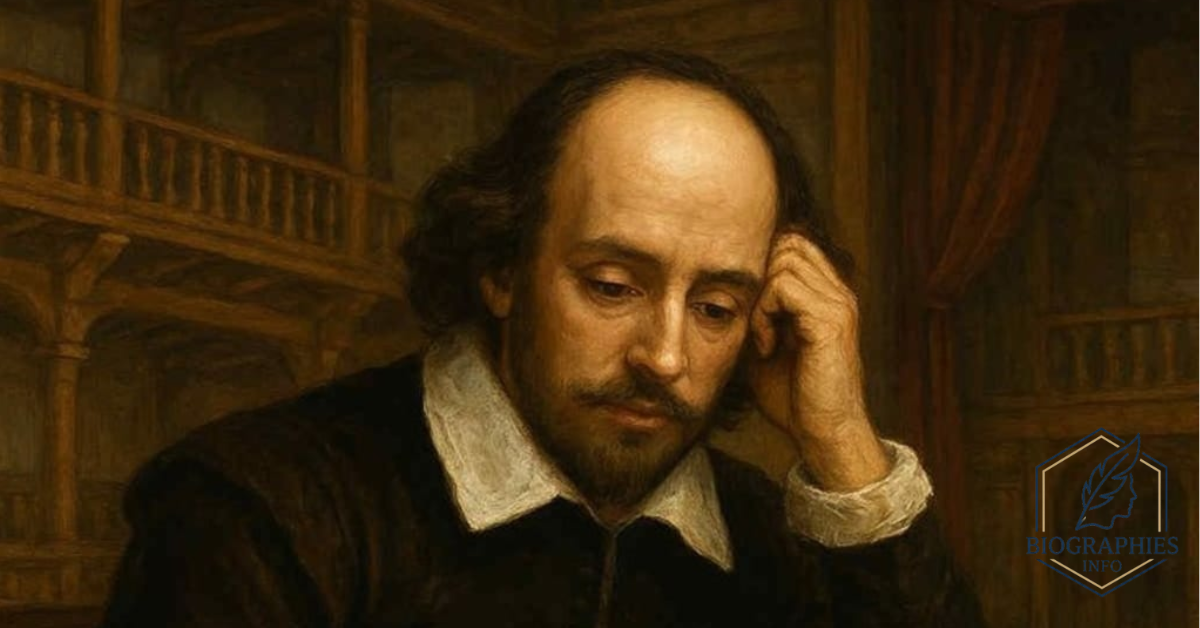
Discover the extraordinary life of William Shakespeare, the most performed, widely quoted, and influential writer in the English language. This comprehensive biography explores every defining chapter of his journey, including his birth, family, marriage, children, literary career, and death.
Who Was William Shakespeare?
William Shakespeare was an English poet, playwright, and actor. He is known as the greatest writer in the English language and often called a national poet. He worked during the Elizabethan and Jacobean eras, his writing style and depth that are still considered as modern storytelling.
Early Life: William Shakespeare’s Childhood and Family
It’s hard to find a surviving record of Shakespeare’s exact birth date. Commonly accepted he was born on April 23, 1564 he was baptised on 26 April 1564 in Stratford-upon-Avon.Tradition has settled on 23 April as his birthday, since that fits the usual three-day gap between birth and baptism at the time.
William Shakespeare Facts at a Glance
Here is a quick snapshot covering the essentials: when he was born, when he died, whom he married, how many children he had, and what he was worth.
| Full Name | William Shakespeare |
| Born | Baptised 26 April 1564; birthday traditionally celebrated 23 April 1564, Stratford-upon-Avon, England |
| Died | 23 April 1616 (aged 52), Stratford-upon-Avon, England |
| Cause of Death | Unknown; historians have proposed fever, stroke, or long-term illness |
| Married | Anne Hathaway, in late 1582 |
| Children | Susanna, and twins Hamnet and Judith |
| Net Worth at Death | Estate and property investments worth roughly £1,000+ in period money (several million dollars today) |
| Known For | 38 plays, 154 sonnets, and 2 narrative poems |
| Nationality | English |
Who Were Shakespeare’s Parents?
John Shakespeare, William’s father ,was a glove-maker who held several civic positions in Stratford, including that of bailiff, roughly equivalent to mayor.Mary Arden was his mother; she came from a well-established local farming family. William was their eldest surviving child among eight.
William Shakespeare’s Siblings
John and Mary Shakespeare had eight children, but only five survived beyond childhood.Joan was their first daughter,died in infancy, as did their second daughter, Margaret. William, born in 1564, was therefore the eldest surviving child.
He grew up alongside four younger siblings who lived to adulthood: brothers Gilbert, Richard, and Edmund, and a sister also named Joan, after her late elder sister who was born in 1569. A fourth younger sister, Anne, died at around seven years old. Of all William’s siblings, only the second Joan outlived him, making her the last of the Shakespeare children still living.
Shakespeare’s Education
William Shakespeare probably attended the King’s New School in Stratford-upon-Avon, where he built a solid foundation of education in reading, writing, Latin, and classical literature. Side by side he developed an interest in drama by watching traveling theatre companies perform in the town.Although, quite few records of his childhood or education have survived.
Historians believe he remained at the school until the age of 14 or 15 before leaving to support his family, and he never attended university. Because there is limited evidence about his education, few people have questioned whether he was truly the author of the works attributed to him.
Shakespeare’s Wife and Marriage
When Shakespeare was just 18 years old, he married Anne Hathaway. At that time she was 26 and already pregnant. According to the Church records the wedding was in late 1582. Their first daughter was born six months after they married, pointing to a rushed union rather than a long courtship.
Shakespeare’s Children
Below is a quick glance of their children and what became of their lives.
| Child | Notes |
| Susanna Shakespeare (1583–1649) | Eldest child; married physician Dr John Hall and inherited most of her father’s estate. |
| Hamnet Shakespeare (1585–1596) | Only son died at age 11, likely of illness, leaving no direct male heir. |
| Judith Shakespeare (1585–1662) | Hamnet’s twin sister married Thomas Quiney shortly before her father’s death. |
Hamnet’s death at age 11 struck hard. Many literary scholars believe that grief later surfaced in the raw emotional weight of Hamlet, written several years afterward.
Shakespeare’s Career and Major Works
William’s writing includes 38 plays, 154 sonnets, and two narrative poems. Besides writing, he also worked as an actor and held a shareholder’s stake in his own theatre company. His great work remains popular to this day.
First Published Work
By 1592, Shakespeare had established himself in London’s theatre scene. He published two narrative poems, Venus and Adonis (1593) and The Rape of Lucrece (1594).
Life With The King’s Men
Shakespeare stayed loyal to a single theatre company for his entire career. Under Queen Elizabeth it operated as The Lord Chamberlain’s Men. After King James I took the throne in 1603, it was renamed The King’s Men under royal patronage. Roughly, Shakespeare produced almost two plays a year for this company and output was extraordinary, sustained for nearly twenty years.
Joining The Lord Chamberlain’s Men
He soon became a founding member of The Lord Chamberlain’s Men, the acting company he would write for over the next two decades.
Plays, Poems, and Sonnets
His major works include tragedy, comedy, history, and romance, alongside some of the most quoted poetry ever written in English. The table below shows his major works by category.
| Category | Notable Works |
| Tragedies | Hamlet, Macbeth, Othello, King Lear, Romeo and Juliet |
| Comedies | A Midsummer Night’s Dream, Twelfth Night, Much Ado About Nothing |
| Histories | Henry V, Richard III, Henry IV Parts 1 and 2 |
| Romances | The Tempest, The Winter’s Tale, Cymbeline |
| Poetry | 154 sonnets, plus Venus and Adonis and The Rape of Lucrece |
The First Folio
No original manuscript of any Shakespeare play survives today.Roughly half of his plays would have been lost entirely if fellow actors from his company had not compiled and published them after his death, in a collection now known as the First Folio.
The ‘Lost Years’ and the Move to London
Shakespear’s lost years were between 1585 and 1592, when Shakespeare’s twins were born, during that period, almost nothing is documented about his life.Historians call this stretch the ‘Lost Years,’ and it remains one of the biggest gaps in his biography.
Buying New Place
Shakespeare’s success in London made him a genuinely wealthy man by Stratford standards. In 1597, he purchased New Place, the largest house in the borough.He kept expanding his property holdings for years afterward, including 107 acres of farmland bought in 1602.
William Shakespeare Net Worth
Pinning an exact figure on Shakespeare’s fortune is difficult, since Tudor-era currency does not translate cleanly into modern money. His will charge his estate with money bequests totalling roughly £350 a considerable sum, given an average Stratford home cost around £30 at the time.
Add in his real estate holdings, estimated at over £900 in property investments, plus his ongoing share of Globe Theatre profits, and Shakespeare emerges as comfortably wealthy rather than fabulously rich.
Why Net Worth Estimates Vary So Widely
Online figures for Shakespeare’s net worth swing from roughly $5 million to hundreds of millions in modern equivalents. Lower estimates track his documented Tudor-era assets, adjusted for inflation.
Higher figures fold in the ongoing cultural and licensing value of his work a measure of legacy, not personal fortune.Historians generally treat his documented bequests and property purchases as the most reliable baseline for what he actually owned when he died.
How Did Shakespeare Die? Death and Final Years
Even a legend’s story must eventually come to an end. William Shakespeare’s final years remain shrouded in mystery, with his exact cause of death still debated by historians centuries later.
Retirement to Stratford
Around 1610, Shakespeare largely stepped back from London life and returned to Stratford-upon-Avon, where he lived at New Place with his family.Recent archaeological evidence suggests he may have divided his time between Stratford and London for longer than historians once assumed, commuting rather than relocating outright.
When Did Shakespeare Die?
William Shakespeare died on 23 April 1616, in Stratford-upon-Avon, at the age of 52. By tradition, this was also his birthday, though like so much of his life, the exact date rests on inference rather than a surviving record. He is buried in the sanctuary of Holy Trinity Church.
What Caused Shakespeare’s Death?
No official cause of death was recorded. Historians have proposed several theories over the centuries, including a sudden fever, a stroke, or a longer illness. A popular but unreliable legend, recorded decades later, claims he fell ill after a heavy drinking session with fellow writers Ben Jonson and Michael Drayton. Most historians treat this as Stratford folklore rather than fact.
Shakespeare’s Legacy
Shaping the English Language
Shakespeare’s influence on the English language is difficult to overstate. He is credited with coining or popularising hundreds of words and phrases still used today.
Still Performed Worldwide
His plays remain constantly in production on stages and screens worldwide, more than four centuries after his death. His work has been translated into dozens of languages and adapted across nearly every medium imaginable, from opera to Hollywood blockbusters.
10 Interesting Facts About William Shakespeare
Here are ten facts about Shakespeare that go beyond the standard textbook summary.
| # | Fact | Why It Matters |
| 1 | Baptised, not officially born-dated | No record states his exact birth date; scholars infer 23 April from his baptism three days later. |
| 2 | Married an older woman | He was 18 when he married Anne Hathaway, who was 26 and already pregnant at the time. |
| 3 | Lost his only son young | His son Hamnet died at age 11, a loss many scholars connect to the grief woven into Hamlet. |
| 4 | The ‘Lost Years’ mystery | Almost nothing is documented about his life between 1585 and 1592, a gap historians still debate. |
| 5 | Invented hundreds of words | He is credited with coining or popularising terms like ‘eyeball,’ ‘lonely,’ and ‘bedroom.’ |
| 6 | Owned a stake in his own theatre | As a shareholder in the Globe Theatre, he earned a cut of ticket sales, not just writing fees. |
| 7 | His plays almost vanished | Roughly half his plays only survive because fellow actors compiled the First Folio after his death. |
| 8 | Left his wife the ‘second-best bed’ | A line in his will that still sparks debate over what it meant about his marriage. |
| 9 | Died on his own birthday | Tradition holds he died on 23 April 1616, the same date long celebrated as his birthday. |
| 10 | No confirmed university education | Despite his literary genius, there is no record he attended university, fuelling authorship debates. |
Famous William Shakespeare Quotes
Shakespeare’s lines remain some of the most quoted in the English language. A few of his best-known include:
- “All the world’s a stage, and all the men and women merely players.” — As You Like It
- “To be, or not to be, that is the question.” — Hamlet
- “We know what we are, but know not what we may be.” — Hamlet
- “Love all, trust a few, do wrong to none.” — All’s Well That Ends Well
Final Thoughts
William Shakespeare’s story is a mix of hard documentation and frustrating gaps. His plays reveal enormous emotional depth, yet his personal life remains partly a mystery even four centuries later. From his rushed marriage to Anne Hathaway to his rise as London’s leading playwright and his quiet retirement in Stratford, understanding his full biography gives far more context than any single quote or play summary ever could.
Frequently Asked Questions
When Was William Shakespeare Born?
He was baptised on 26 April 1564. His birthday is traditionally celebrated on 23 April 1564, though no exact birth record survives.
How Did Shakespeare Die?
His exact cause of death is unknown. Historians have proposed fever, stroke, or a longer illness, though no medical record survives to confirm any single theory.
Who Was Anne Hathaway, Wife of Shakespeare?
Anne Hathaway was a farmer’s daughter from near Stratford-upon-Avon who married Shakespeare in 1582, when she was 26 and he was 18.They had three children together and remained married until his death in 1616.
William Shakespeare Nationality
William Shakespeare’s nationality was English. He was born and raised in Stratford-upon-Avon, England, and based for most of his career in London.
William Shakespeare Awards
Shakespeare worked before formal literary prizes existed, so there are no William Shakespeare awards in the modern sense.His true recognition came through royal patronage, first from Elizabeth I and later James I, and through the enduring popularity of his work.